What's Actually Carrying Your Drops? A Neighbourly Look at CBD Carrier Oils
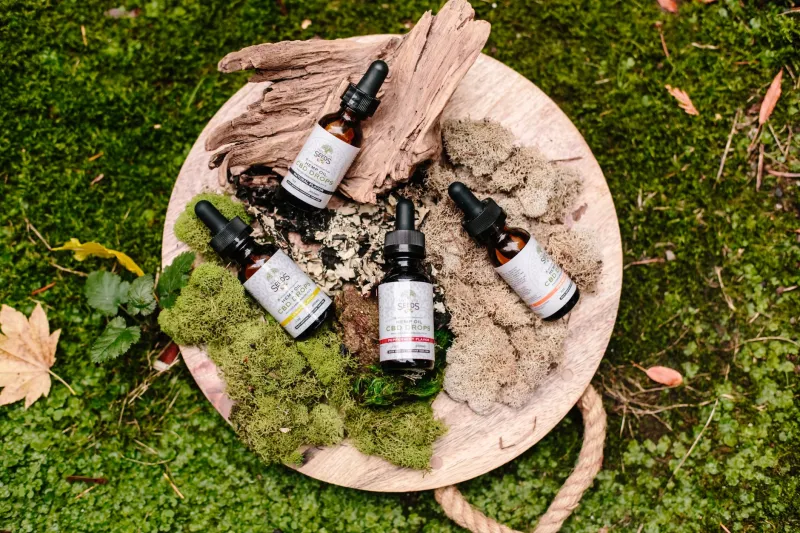
Stand at our counter for long enough and you'll hear the same question in about four different accents: "So what's actually in it, then?" Fair enough. Most people come in knowing roughly how many milligrams they're after, then get ambushed by a label that reads like an A-level chemistry paper. The bit that trips people up most often isn't the CBD itself — it's the oil it's swimming in.
Carrier oils don't get much airtime on the front of the bottle. They're the quiet supporting act, the thing that decides whether your drops taste of nothing much, taste faintly of salad, or taste like you've licked a garden. None of these are disasters. But they do change how a bottle behaves in your hand, in your mouth and in your kitchen cupboard. So let's walk through the three you'll meet most often, without turning it into a lecture.
First things first: what the carrier actually does
CBD on its own is a thick, resinous substance. You wouldn't want to measure it out with a teaspoon, and you certainly wouldn't want to swallow it neat. The carrier oil dilutes it into something you can drop under your tongue, stir into a brew or add to a spoon of yoghurt. It also carries the flavour, sets the texture and — in a practical, unglamorous way — determines how long the bottle keeps once you've opened it.
Think of it like the bread in a sandwich. The filling gets the attention, but a soggy slice ruins the whole thing. The right carrier for you is the one you'll actually use without flinching.
MCT oil: the smooth all-rounder
MCT stands for medium-chain triglycerides, and yes, that is the point where most people's eyes glaze over. In practice, it's a fractionated coconut oil — thin, light, almost watery in consistency, and famously close to tasteless. If you've had drops before and thought "I can't really taste anything," you've probably had MCT.
It's the most common choice in CBD drops for a few sensible reasons. It's thin enough to measure neatly from a dropper, it doesn't cling to the glass, and it plays nicely with added flavourings like peppermint or orange. If you're the sort of person who winces at anything vaguely medicinal, MCT is the gentle option.
The trade-off is that it's a bit anonymous. Some people find it almost too neutral, and if you're hoping for a product that feels like a proper kitchen ingredient, it won't scratch that itch. There's also the coconut origin to flag — not usually an issue at the drop level, but worth mentioning if you're sensitive to it or avoiding coconut for any reason.
Olive oil: the old-fashioned one
Olive oil has been used as a carrier for plant extracts for centuries, which is partly why it still turns up in artisanal bottles and small-batch ranges. It's thicker, glossier and has a distinctly savoury character. Under the tongue, it feels more substantial — almost like a very mild cooking oil — and the taste lingers a touch longer.
Where it shines is in bottles aimed at people who want something that feels more like food and less like a supplement. A good extra-virgin olive oil brings a peppery note that some drinkers genuinely enjoy. Where it stumbles is consistency. Olive oil thickens in the cold, so a bottle kept near a chilly window in February can turn sluggish and awkward to drop. It's also a louder flavour — fine if you like it, less fine if you don't.
If you're someone who already cooks with olive oil daily and doesn't mind a savoury edge, this is a perfectly sensible choice. If you want your drops to disappear into a morning tea without comment, probably not.
Hemp seed oil: the one with the green taste
Hemp seed oil is the most characterful of the three. It's deep green, nutty, slightly grassy and — there's no polite way to say this — it tastes like hemp. Some people love that; it feels honest and plant-forward. Others take one drop and pull a face.
Texture-wise it sits between MCT and olive oil: not watery, not syrupy. It's often chosen by brands who want a full-spectrum product that feels closer to the whole plant, and it brings its own nutritional profile to the party. The catch is that it's the least forgiving of the three if you're sensitive to flavour, and it can overpower added essential oils.
A practical note worth knowing: hemp seed oil has a shorter shelf life than MCT. Once opened, it wants to be used within a reasonable window and kept cool and dark. If you're the sort of person who buys a bottle and forgets about it for four months, that matters.
How to choose without overthinking it
Here's the short version we'd give a neighbour standing at the counter with two bottles in hand.
Pick MCT if you want something discreet, thin and easy to measure, and you'd rather not taste your drops at all.
Pick olive oil if you like the idea of a richer, foodier bottle, you don't mind a savoury note, and you'll keep it somewhere reasonably warm.
Pick hemp seed oil if you actively want that green, nutty flavour and you'll use the bottle steadily rather than leave it languishing at the back of a cupboard.
That's it. No chemistry degree required.
Questions worth asking at the counter
Rather than squinting at the back label on your own, ask us directly. Good ones include: which carrier is in this bottle, and why did you choose it? How does it behave in the cold? How long does it keep once opened? Can I try a drop on the back of my hand to get a sense of the texture before I commit?
A decent shop should be happy to answer all four without reaching for a brochure. If a brand can't tell you what's carrying its CBD, that's usually a sign it hasn't thought very hard about the experience of actually using it.
One last practical thought
The carrier oil is not the headline ingredient, and it doesn't need to be. But it's the bit you'll notice every single day — the taste on your tongue, the feel of the dropper, the way the bottle behaves when the kitchen gets cold. Choose the one that fits your habits rather than the one with the boldest label, and you'll be far more likely to finish the bottle rather than leave it gathering dust beside the vinegar.
And if you're still not sure, pop in. We'll talk it through over the counter, no rush.